

Beauty Therapies Pre-Application Briefing
Successful applicants who meet the course entry criteria will be invited to a formal interview, which will include a written task and an interview to discuss their application. Please refer to the information on this page to prepare for your interview task.
The formal interview is scored based on presentation and communication skills.
Facial Muscles
Facial muscles are divided into 2 diverse groups: the muscles of facial expression and the muscles of mastication. The muscles of facial expression include the frontalis, which raises the eyebrows and wrinkles the forehead. Risoriu,s which draws the corners of the mouth out and back. Corrugator, which draws the eyebrows down and together, and Zygomaticus, which raises the corners of the mouth up. The muscles of mastication move the jaw and aid chewing. An example would be Masseter which closes the jaw and clenches the teeth. Facial muscles have 3 different attachments: skin, bone and other muscles.
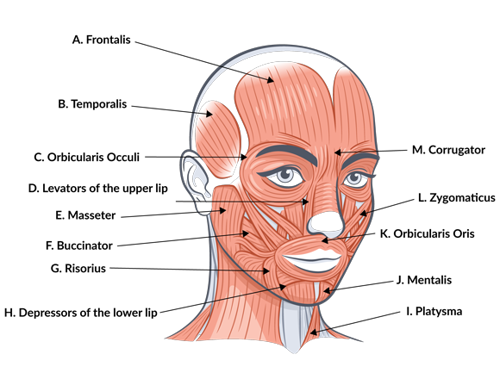
- A - Frontalis
- B - Emporalis
- C - Orbicularis Occuli
- D - Levators of the upper lip
- E - Masseter
- F - Buccinator
- G - Risorius
- H - Depressors of the lower lip
- I - Platysma
- J - Mentalis
- K - Orbicularis Oris
- L - Zygomaticus
- M – Corrugator
The lymphatic system
The lymphatic system is closely related to the circulatory system
It consists of a network of vessels that assist the circulatory system to ensure adequate and efficient drainage from the cells and tissues
A healthy body requires an efficient drainage system to remove waste products and toxins from cells, which would otherwise build up in tissues, causing swelling (oedema) and poisoning.
The lymphatic system, unlike the blood circulatory system, has no ‘pump’ action (the heart) to help move fluid through the vessels.
It therefore relies on the squeezing action of skeletal muscle during contraction to compress the lymphatic vessels and move the fluid along, draining it to the nodes.
The circulatory system consists of the heart, blood, and blood vessels. The heart acts as a pump for the blood, which, when oxygenated, travels through the arteries to the tissues of the body and then back to the heart via the veins. The arteries are thicker-walled, elastic, and do not contain valves. Veins have thinner walls because they do not carry blood under pressure and contain valves to prevent backflow.
Blood is composed of Plasma, Erythrocytes, leucocytes, and thrombocytes, and its main function is transport, defence, clotting, and heat regulation.